


News

Share
Published 10:06 13 May 2022 BST
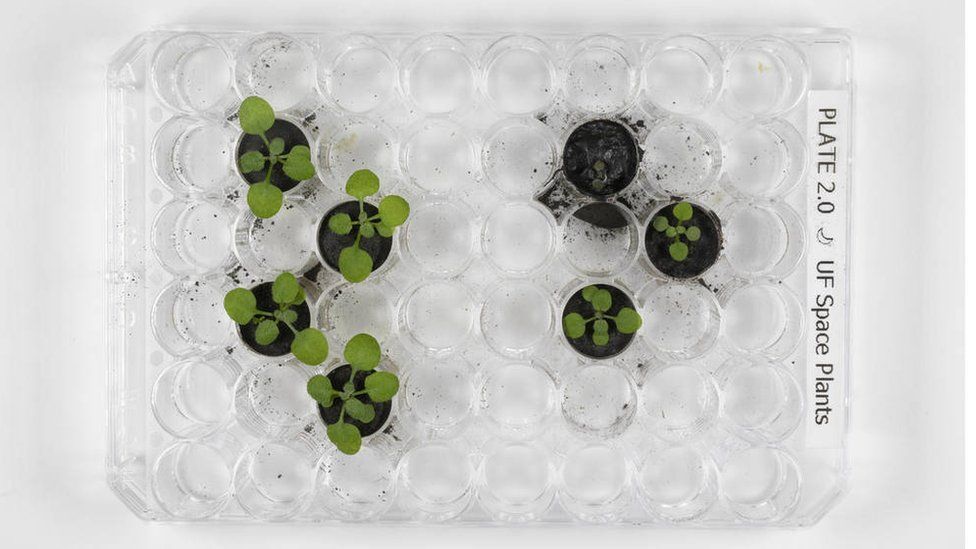 Credit: University of Florida[/caption]
The study also looked at the ways in which plants respond biologically to growth in a substance that wasn't originated on Earth - in this case lunar soil. It's a process that's commonly referred to as 'lunar regolith' and is known to be radically different to what we typically see here on Earth, according to the University of Florida website.
"I can't tell you how astonished we were," explained University of Florida professor Anna-Lisa Paul, one of the researchers that co-authored the paper that revealed these out-of-this-world results.
"Every plant - whether in a lunar sample or in a control - looked the same up until about day six."
After six days of incubation, the plants that had sprouted from the lunar soil began to display differences. For example, some started to look stunted, show signs of stress or develop at a slower pace.
Still, scientists are asserting that this work is undeniably a breakthrough - and one with very real implications for our own future.
"This research is critical to Nasa's long-term human exploration goals as we'll need to use resources found on the Moon and Mars to develop food sources for future astronauts living and operating in deep space," said NASA chief Bill Nelson.
"This fundamental plant growth research is also a key example of how Nasa is working to unlock agricultural innovations that could help us understand how plants might overcome stressful conditions in food-scarce areas here on Earth."
Rather unsurprisingly, there's not much lunar soil here on Earth after Nasa astronauts managed to return just 382kg (842lb) of Moon material like rocks, pebbles, sand and core samples during missions across a three-year period beginning in 1969.
Despite this, these Floridian professors were still able to show amazing results regardless of only having 1g of soil per plant to work with.
Hopefully this could all be set to change in 2025, when a new NASA mission plans to land astronauts on the lunar surface for the first time since 1972.
Related links:
Credit: University of Florida[/caption]
The study also looked at the ways in which plants respond biologically to growth in a substance that wasn't originated on Earth - in this case lunar soil. It's a process that's commonly referred to as 'lunar regolith' and is known to be radically different to what we typically see here on Earth, according to the University of Florida website.
"I can't tell you how astonished we were," explained University of Florida professor Anna-Lisa Paul, one of the researchers that co-authored the paper that revealed these out-of-this-world results.
"Every plant - whether in a lunar sample or in a control - looked the same up until about day six."
After six days of incubation, the plants that had sprouted from the lunar soil began to display differences. For example, some started to look stunted, show signs of stress or develop at a slower pace.
Still, scientists are asserting that this work is undeniably a breakthrough - and one with very real implications for our own future.
"This research is critical to Nasa's long-term human exploration goals as we'll need to use resources found on the Moon and Mars to develop food sources for future astronauts living and operating in deep space," said NASA chief Bill Nelson.
"This fundamental plant growth research is also a key example of how Nasa is working to unlock agricultural innovations that could help us understand how plants might overcome stressful conditions in food-scarce areas here on Earth."
Rather unsurprisingly, there's not much lunar soil here on Earth after Nasa astronauts managed to return just 382kg (842lb) of Moon material like rocks, pebbles, sand and core samples during missions across a three-year period beginning in 1969.
Despite this, these Floridian professors were still able to show amazing results regardless of only having 1g of soil per plant to work with.
Hopefully this could all be set to change in 2025, when a new NASA mission plans to land astronauts on the lunar surface for the first time since 1972.
Related links:

News

News

News

News
Why Google wants to release 32,000,000 infected mosquitoes into the wild
It’s not quite as crazy as it sounds Google wants to release 32,000,000 disease-infected mosquitoes into the wild. Yes, you heard that right, and while this may sound like the evil masterplan of a crazed villain, the project is actually one of goodwill for the betterment of humanity. For thousands of years, humans have been […]
News
11h
All the reviews for Clarkson’s Farm Series 5 as audience favourite returns
It seems people are divided The new season of Clarkson’s Farm focuses on Jeremy Clarkson’s efforts to modernise Diddly Squat Farm, as he deals with major farming challenges, a changing political landscape, and the growing demands of running his new pub. Season 5 of the documentary reality series begins after a health scare forces Jeremy […]
News
11h
Amazon confirms exact dates for four-day Prime Day event
News


