




Health

Share
Published 11:25 6 Jan 2022 GMT
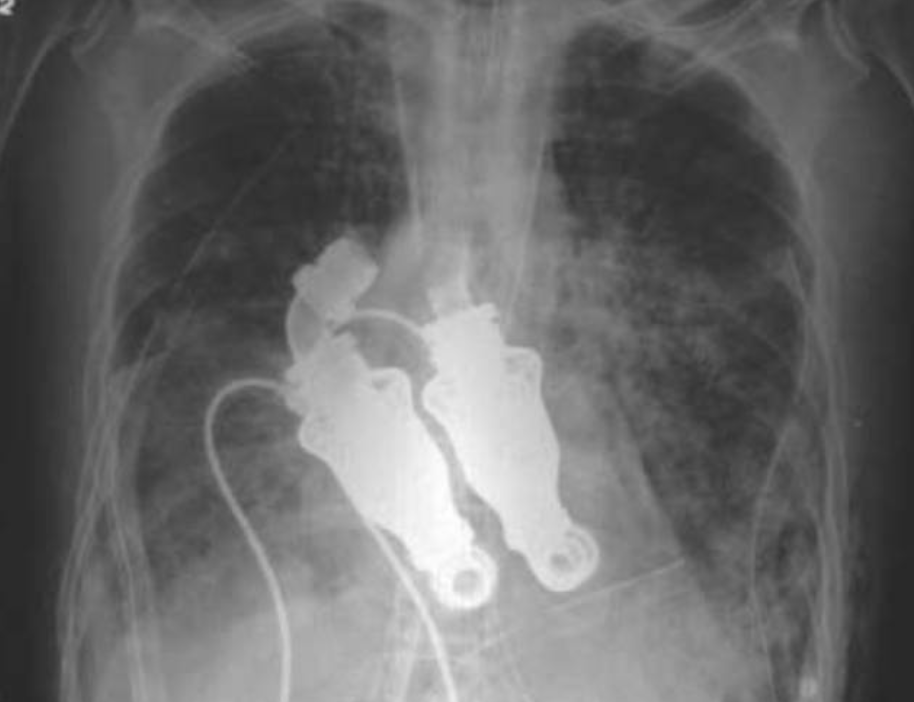 Lewis' heart was completely removed/Via Texas Heart Institute[/caption]
After decades of trial and error, two doctors at the Texas Heart Institute developed a device that used whirling rotors to replace the heart's pumping function.
Dr Billy Cohn and Dr Buz Frazier initially began trials on animals, most notably on an eight-month-old calf named Abigail. By removing her heart and replacing it with two centrifugal pumps, blood was circulated around Abigail's body without the need for a typical heart.
"By every metric we have to analyse patients, she's not living," Cohn told NPR at the time.
"But here you can see she's a vigorous, happy, playful calf licking my hand."
The doctors practised on a further 38 calves before progressing onto human trials.
Lewis suffered from amyloidosis, a rare disease that causes a build-up of abnormal proteins that results in rapid heart, kidney and liver failure.
Doctors had given the 55-year-old only 12 hours to live - but his wife Linda was not prepared to give up.
"He wanted to live, and we didn't want to lose him," she said.
"You never know how much time you have, but it was worth it."
Cohn and Frazier were able to remove the man's heart and replace it with their revolutionary device.
Linda said: "I listened and it was a hum, which is amazing. He didn't have a pulse."
[caption id="attachment_309882" align="alignnone" width="920"]
Lewis' heart was completely removed/Via Texas Heart Institute[/caption]
After decades of trial and error, two doctors at the Texas Heart Institute developed a device that used whirling rotors to replace the heart's pumping function.
Dr Billy Cohn and Dr Buz Frazier initially began trials on animals, most notably on an eight-month-old calf named Abigail. By removing her heart and replacing it with two centrifugal pumps, blood was circulated around Abigail's body without the need for a typical heart.
"By every metric we have to analyse patients, she's not living," Cohn told NPR at the time.
"But here you can see she's a vigorous, happy, playful calf licking my hand."
The doctors practised on a further 38 calves before progressing onto human trials.
Lewis suffered from amyloidosis, a rare disease that causes a build-up of abnormal proteins that results in rapid heart, kidney and liver failure.
Doctors had given the 55-year-old only 12 hours to live - but his wife Linda was not prepared to give up.
"He wanted to live, and we didn't want to lose him," she said.
"You never know how much time you have, but it was worth it."
Cohn and Frazier were able to remove the man's heart and replace it with their revolutionary device.
Linda said: "I listened and it was a hum, which is amazing. He didn't have a pulse."
[caption id="attachment_309882" align="alignnone" width="920"]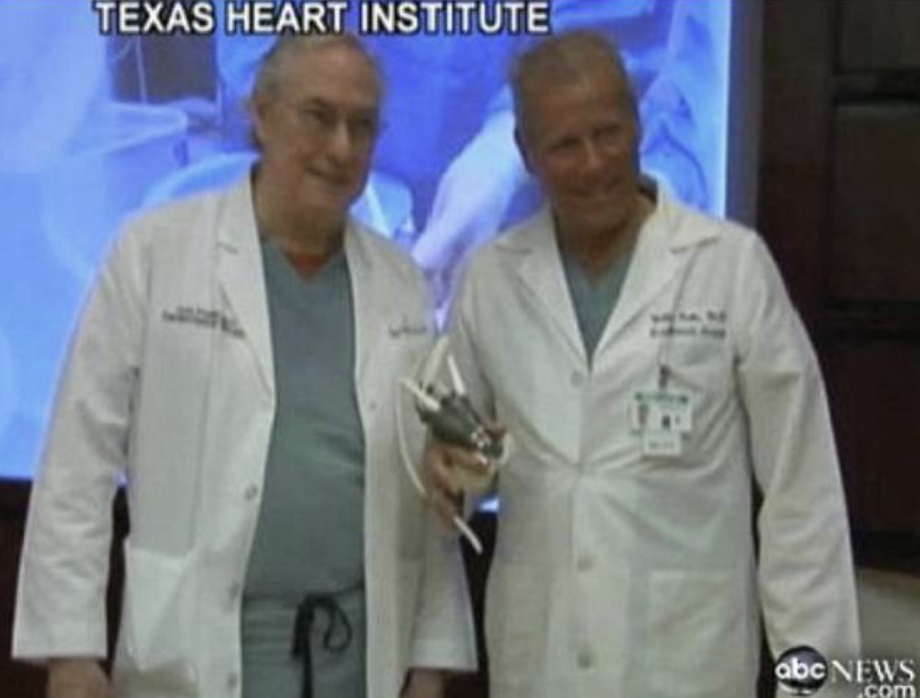 Dr Billy Cohn and Dr Buz/Via ABC[/caption]
Explaining how the device works, Cohn said it was made with: "Dacron on the inside and fiberglass impregnated in silicone on the outside.
"There's a moderate amount of homemade stuff on here."
The doctors said that the pump should last longer than other artificial hearts and would even cause fewer problems.
"We look at all the animals, insects, fish, reptiles and certainly all mammals, and see a pulsatile circulation," Cohn explained.
"And so all the early research and all the early efforts were directed at making pulsatile pumps.
"The pulsatility of the flow is essential for the heart, because it can only get nourishment in between heartbeats.
"If you remove that from the system, none of the other organs seem to care much."
While Lewis was able to wake up and being recovery, his amyloidosis began to attack his liver and kidneys. He sadly passed away in April of the same year.
While his death was undoubtedly heartbreaking for those close to him, doctors said that his new artificial heart was working flawlessly.
Dr Billy Cohn and Dr Buz/Via ABC[/caption]
Explaining how the device works, Cohn said it was made with: "Dacron on the inside and fiberglass impregnated in silicone on the outside.
"There's a moderate amount of homemade stuff on here."
The doctors said that the pump should last longer than other artificial hearts and would even cause fewer problems.
"We look at all the animals, insects, fish, reptiles and certainly all mammals, and see a pulsatile circulation," Cohn explained.
"And so all the early research and all the early efforts were directed at making pulsatile pumps.
"The pulsatility of the flow is essential for the heart, because it can only get nourishment in between heartbeats.
"If you remove that from the system, none of the other organs seem to care much."
While Lewis was able to wake up and being recovery, his amyloidosis began to attack his liver and kidneys. He sadly passed away in April of the same year.
While his death was undoubtedly heartbreaking for those close to him, doctors said that his new artificial heart was working flawlessly.

Health

Health

Health

Health
Doctor reveals what foods he saw in diets of 80% of colon cancer cases
An oncologist has revealed what he saw in most patients Colon cancer has seen an alarming rise worldwide, with experts warning that lifestyle may be playing a big part in its rise. It’s one of the most common types of cancer in the UK, with young people being particularly affected. Diet has long been known […]
Health
2 weeks ago
Two doses of nasal spray found to slow brain ageing and restore memory
The effects last months A new study has revealed that there is a new nasal spray which an reduce brain inflammation and restore memory dramatically. And this can happen in just two doses with effects lasting months, thanks to the new spray developed by scientists. The brain fog one experiences as they grow older is […]
Health
1 month ago
Man becomes father after having four inches of penis amputated
Health


